
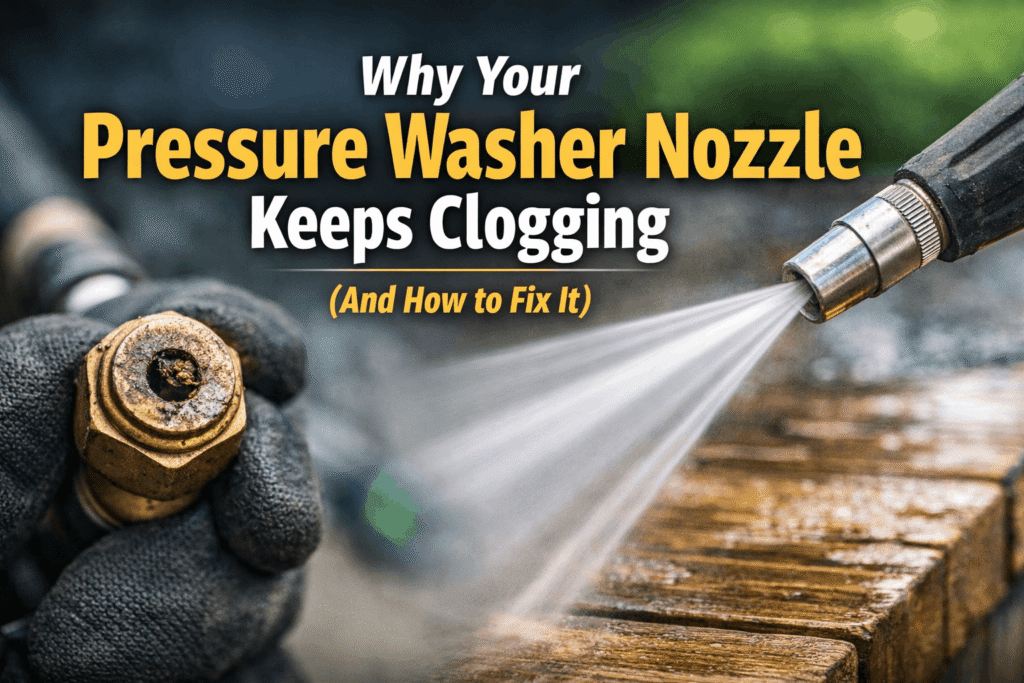
In this post, I’m breaking down why pressure washer nozzles clog so often, what’s actually causing it in most setups, and how to fix the real problem instead of just cleaning the nozzle over and over. You’ll see what to check in your system, how to clean a clogged nozzle the right way, and what to change so it doesn’t keep happening on future jobs.
Alright, let’s talk about a problem that wastes way more time than it should.
If your pressure washer nozzle keeps clogging, it’s not random.
And it’s usually not because the nozzle itself is “bad.”
What’s really happening is that something upstream is wrong, and the nozzle is just where the problem finally shows up.
Once you understand that, fixing this becomes straightforward.
How nozzle clogging actually happens
Think of your pressure washer as a system, not individual parts.
Water comes in, moves through filters, hoses, injectors, and fittings, and the very last stop is the nozzle. That nozzle opening is tiny. So anything that slips through the system has exactly one place to get stuck.
That’s why cleaning or replacing the nozzle over and over doesn’t solve the issue. You’re fixing the symptom, not the cause.
The most common reasons nozzles clog
The first and most common cause is debris entering the system.
If you’re pulling water from a tank, barrel, or job site supply, dirt and grit are getting in, whether you see them or not. Small particles move through the system just fine until they reach the nozzle. Then pressure drops instantly, and the nozzle plugs.
You’ll notice this when the nozzle works fine, suddenly clogs, you clean it, and the same thing happens again later. That pattern is your giveaway.
Another big one is hard water mineral buildup.
This one doesn’t happen overnight, which is why people miss it. Minerals slowly build up inside the nozzle orifice, narrowing the opening over time. Eventually, pressure drops or the nozzle clogs completely, even though the water looks clean.
If you’re seeing gradual performance loss or chalky residue, mineral buildup is likely the issue. Periodic descaling and flushing with clean water after use goes a long way here.
The fix here isn’t another nozzle. It’s better filtration and regular flushing before the nozzle ever goes on
Chemical residue is another major culprit, especially with soft washing.
When detergent or soft wash mixes dry inside the nozzle, they harden. The next time you fire up the machine, there’s nowhere for that residue to go. The result is a clogged nozzle before you even start working.
This usually shows up when everything worked fine on the last job, but the nozzle is completely blocked the next time you use it. The fix is simple but often skipped: always flush the system with clean water after chemical use and avoid storing equipment with chemicals still in the line.
This is especially common with soft washing setups that rely on injectors or proportioners.
Using the wrong nozzle size is a quieter but more damaging issue.
When the nozzle orifice is too small for your machine’s GPM, pressure spikes. Instead of debris passing through, it gets jammed. Over time, this causes frequent clogging and can even damage the pump.
If pressure feels inconsistent, the nozzle vibrates, or clogging happens under load, sizing is worth checking. Guessing here costs money.
Finally, nozzles wear out.
They’re consumables. The orifice wears unevenly, spray patterns distort, and debris gets trapped more easily. If a nozzle keeps clogging even with clean water and proper filtration, replacement is usually the smart move.
Trying to stretch a worn nozzle only increases downtime.
Cleaning a clogged nozzle the right way
Cleaning isn’t complicated, but people still mess it up.
Shut off the machine, remove the nozzle, clear the blockage with a proper cleaning tool or fine wire, then flush backward with clean water before reinstalling. That’s it.
Forcing oversized objects into the opening is how nozzles get permanently damaged.
How to stop this from happening again
This problem only becomes routine if you let it.
Proper filtration, flushing after chemical use, correct nozzle sizing, and replacing worn nozzles early eliminate most clogging issues. When those basics are handled, nozzle clogs become rare instead of constant.
When replacement is the smarter option
If you’re cleaning the same nozzle every job, that’s your answer.
When cleaning doesn’t restore pressure, the spray pattern stays uneven, or clogs keep happening despite clean water, replacement saves more time than it costs.
Final takeaway
A clogged pressure washer nozzle isn’t bad luck.
It’s feedback from your system.
Fix the real cause instead of fighting the nozzle, and your entire setup becomes more reliable, more efficient, and a lot less frustrating.
